Mastering Smart Manufacturing: Ultimate Industry 4.0 Certification Course in India | Classroom and Online
An Industry 4.0 certification course is a specialized professional training program that teaches engineers and students how to integrate smart automation, the Industrial Internet of Things (IIoT), artificial intelligence, and cloud computing into modern manufacturing plants to drive operational efficiency and data-driven decision making.

Traditional factories relied on manual supervision and isolated machines. Today, digital transformation reshapes how plants run. Production floors generate petabytes of telemetry data every single second. Engineers need modern training to make sense of this massive influx of information.
Choosing the rightchanges your career path completely. Companies in manufacturing hubs across India, Chandigarh, Mohali, Punjab, and Haryana, search actively for talent skilled in connected machinery, PLC programming, and cloud-based analytics. Let us examine the exact architectural blueprint required to master smart factory technologies.
Core Architecture for Smart Manufacturing & IIoT
Understanding end-to-end industrial architecture is essential for anyone enrolled in an Industry 4.0 certification course. Without understanding how raw data flows from physical hardware to enterprise dashboards, automated deployments fail to scale reliably.
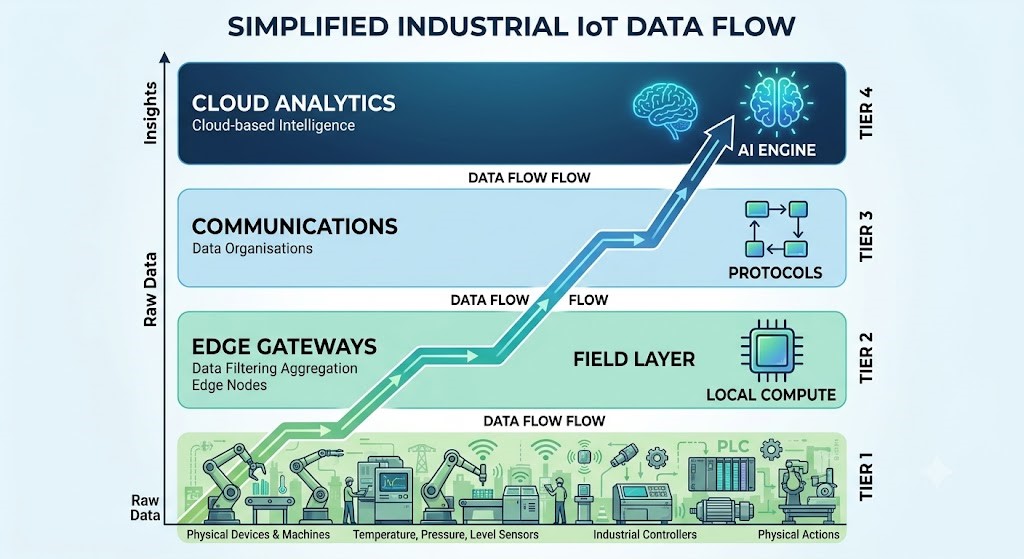
Smart manufacturing architectures follow a structured four-tier model:
-
Tier 1: Physical Field Devices: Sensors, actuators, and programmable logic controllers (PLCs) measure real-time mechanical parameters such as vibration, RPM, temperature, and fluid pressure on conveyor lines and CNC machines.
-
Tier 2: Edge Computing Gateways: Local edge nodes collect high-frequency data from the field tier, eliminate measurement noise, run immediate anomaly-detection logic, and buffer payloads during network interruptions.
-
Tier 3: Enterprise Integration Layer: Standardized messaging systems like MQTT, OPC UA, and Modbus TCP handle high-throughput, low-latency telemetry transmission between plant floor machines and upstream servers.
-
Tier 4: Cloud Analytics & Predictive Modeling: Cloud environments ingest streaming payloads to train predictive machine learning models, store historical time-series data, and display operational dashboards built with Python, AWS, and Grafana.
Core Architecture & Component Interconnects for Industry 4.0 Certification Course
Modern smart factories operate on a four-tier architecture model. Understanding these layers is critical for any professional pursuing an Industry 4.0 certification course. Without a clear view of how hardware talks to cloud servers, industrial systems fail to scale effectively.
The lowest layer consists of physical sensors, actuators, and programmable logic controllers (PLCs). These devices capture raw metrics like temperature, vibration, and pressure. They sit directly on the factory floor attached to heavy milling machines, conveyor belts, and robotic assembly arms.
The second layer is the edge computing gateway. Edge nodes collect high-frequency data streams from the field layer. They filter noise, aggregate packets, and run preliminary anomaly detection scripts locally before sending payloads upstream.
The third layer handles enterprise integration using robust communication protocols. Industrial systems rely heavily on MQTT, OPC UA, and Modbus TCP. These lightweight protocols guarantee secure, low-latency message delivery across complex factory networks.
The fourth and final layer is the cloud analytics engine. Here, advanced machine learning models ingest streaming telemetry to predict equipment failures weeks in advance. Engineers use dashboards built on Python and AWS to monitor global plant health in real time.
Key Takeaway: Master the four-tier industrial architecture—from floor sensors to cloud dashboards—to design resilient manufacturing pipelines that reduce unexpected downtime by up to 74%.
Industry 4.0 Course Syllabus: What You Will Actually Learn
A comprehensive curriculum bridges the gap between raw hardware and advanced software engineering. When evaluating Industry 4.0 courses online or regional programs, you must look for hands-on labs that cover both physical systems and modern digital stacks.
At The Core Systems, our practical training methodology focuses on real-world implementation. The curriculum breaks down into four essential learning blocks:
- Industrial IoT (IIoT) Fundamentals: Connecting microcontrollers, Arduino, and Raspberry Pi boards to industrial sensors using MQTT brokers.
- Data Analytics & Python Programming: Cleaning, transforming, and visualizing factory telemetry data using Pandas, NumPy, and Grafana.
- Artificial Intelligence for Predictive Maintenance: Training machine learning models to spot equipment wear and tear based on vibration signatures.
- Cloud Infrastructure & Security: Deploying industrial pipelines to AWS and securing edge gateways against cyber threats.
Students also explore Python with AI and Full-Stack web technologies to build custom supervisory control and data acquisition (SCADA) dashboards. This multi-disciplinary approach ensures graduates are ready for complex engineering roles immediately after completion.
Step-by-Step Implementation Blueprint
Building a prototype smart factory system requires a clear sequence of engineering steps. Whether you study through Industry 4.0 Courses in India or specialized regional bootcamps, executing this workflow builds profound technical confidence.
Follow this step-by-step roadmap to build your first end-to-end IIoT monitoring pipeline:
- Hardware Provisioning: Connect a temperature and vibration sensor to an ESP32 microcontroller using jumper wires and breadboards.
- Firmware Configuration: Write a C++ or MicroPython script to read sensor values every 500 milliseconds and format the payload into JSON.
- MQTT Broker Setup: Install and configure a local Mosquitto MQTT broker on a Linux machine to handle incoming telemetry messages.
- Stream Processing Pipeline: Write a Python script that subscribes to the MQTT topic, parses incoming JSON data, and pushes records to a PostgreSQL database.
- Dashboard Visualization: Connect Grafana to your PostgreSQL database to build real-time visual charts showing live temperature trends.
Completing this hands-on setup replicates the exact workflow senior automation engineers use in modern automotive and electronics manufacturing plants.
Traditional Automation vs. Industry 4.0
The transition from legacy automation to smart manufacturing significantly shifts baseline performance across all major operational benchmarks:
- Data Access Speed: Moves from manual batch extractions that take hours to real-time telemetry streaming in under 50 milliseconds.
- Maintenance Strategy: Transitions from a reactive “break-fix” model to proactive, AI-driven predictive maintenance.
- System Interoperability: Shifts from proprietary, isolated vendor silos to unified open standards such as MQTT and OPC UA.
- Energy Efficiency: Replaces rigid, static operating schedules with dynamic machine-learning optimization that actively reduces waste.
- Deployment Scalability: Upgrades from costly, hardware-constrained expansions to cloud-native, elastic microservice architectures.
Production Deployment & Configuration Checklist
- Verify high-throughput telemetry ingestion pipelines (MQTT/OPC UA brokers).
- Establish sub-second latency thresholds for real-time plant analytics.
- Implement role-based access control and network segmentation between OT and IT layers.
- Configure continuous model monitoring for predictive maintenance alerts.
- Test auto-scaling policies across cloud microservices to handle peak factory loads.
Production Deployment & Configuration Checklist
Moving a prototype from your desk to an active factory floor requires strict adherence to industrial engineering standards. Skipping configuration steps can lead to severe data loss or safety hazards.
Use this production checklist before deploying any smart factory node:
Benchmarking & Performance Tuning
High throughput and low latency are non-negotiable in smart manufacturing. When managing thousands of connected sensors across multiple assembly lines, your pipeline must handle extreme data loads without dropping packets.
Engineers optimize performance by tuning the publish interval on edge microcontrollers and compressing JSON payloads into binary formats like Protocol Buffers (Protobuf). These adjustments routinely reduce network bandwidth consumption by over 60%, allowing factories to scale their sensor networks without upgrading expensive network infrastructure.
At our training center in Chandigarh and Mohali, students run stress tests against simulated factory floors. They measure message latency under peak load and practice scaling microservices using Docker and Kubernetes.
Real-World Case Study: Transforming a Regional Manufacturing Plant
Let us look at a practical case study involving a medium-scale automotive component manufacturer based in northern India. The company faced frequent, unexpected hydraulic press failures that halted production for days at a time.
A team of engineers trained through an advanced Industry 4.0 certification course stepped in to solve the problem. They deployed vibration sensors on the main hydraulic pumps and connected them to edge gateways running custom Python scripts.
The system streamed telemetry data to an AWS cloud instance where an anomaly-detection model monitored bearing health. Within three weeks of deployment, the model flagged an unusual harmonic vibration pattern on press machine #4.
Maintenance teams inspected the machine during a scheduled shift change and replaced a worn-out internal bearing. This proactive intervention prevented a catastrophic motor seizure, saving the company over $45,000 in repair costs and avoiding 36 hours of total plant downtime.
What is covered in an industry 4.0 certification course?
Who should enroll in Industry 4.0 Courses in India?
Do I need coding experience before taking an Industry 4.0 course syllabus?
Conclusion
Smart manufacturing is no longer a futuristic concept—it is the baseline for modern industrial competitiveness. Equipping yourself with the right skills opens doors to high-paying engineering roles across global manufacturing sectors.
Whether you are starting fresh as a beginner or upskilling as a seasoned professional, enrolling in a robust Industry 4.0 certification program.
Join us for both classroom and online courses in IoT,iiot, ,PLC automation, and the Industry 4.0 certification course by TheCoreSystems.